

DV/IPV-informed AI response evaluation platform
Working technical preview with five-configuration comparison, a 12-dimension evaluation framework, simulated scenarios, human-review flags, exports, history, and reviewer education tools.
Asset typeSoftware IP Asset
Structured AI response comparison for DV/IPV and survivor-serving contexts
EchoCheck is a pre-revenue technical-preview platform for structured AI response evaluation in DV/IPV and survivor-serving contexts. It runs the same simulated request through five prompt configurations, applies a schema-validated 12-dimension evaluation layer, and creates review records for qualified human analysis. Gate 1 approval, independent subject-matter validation, approved production host, and live-environment verification remain pending.
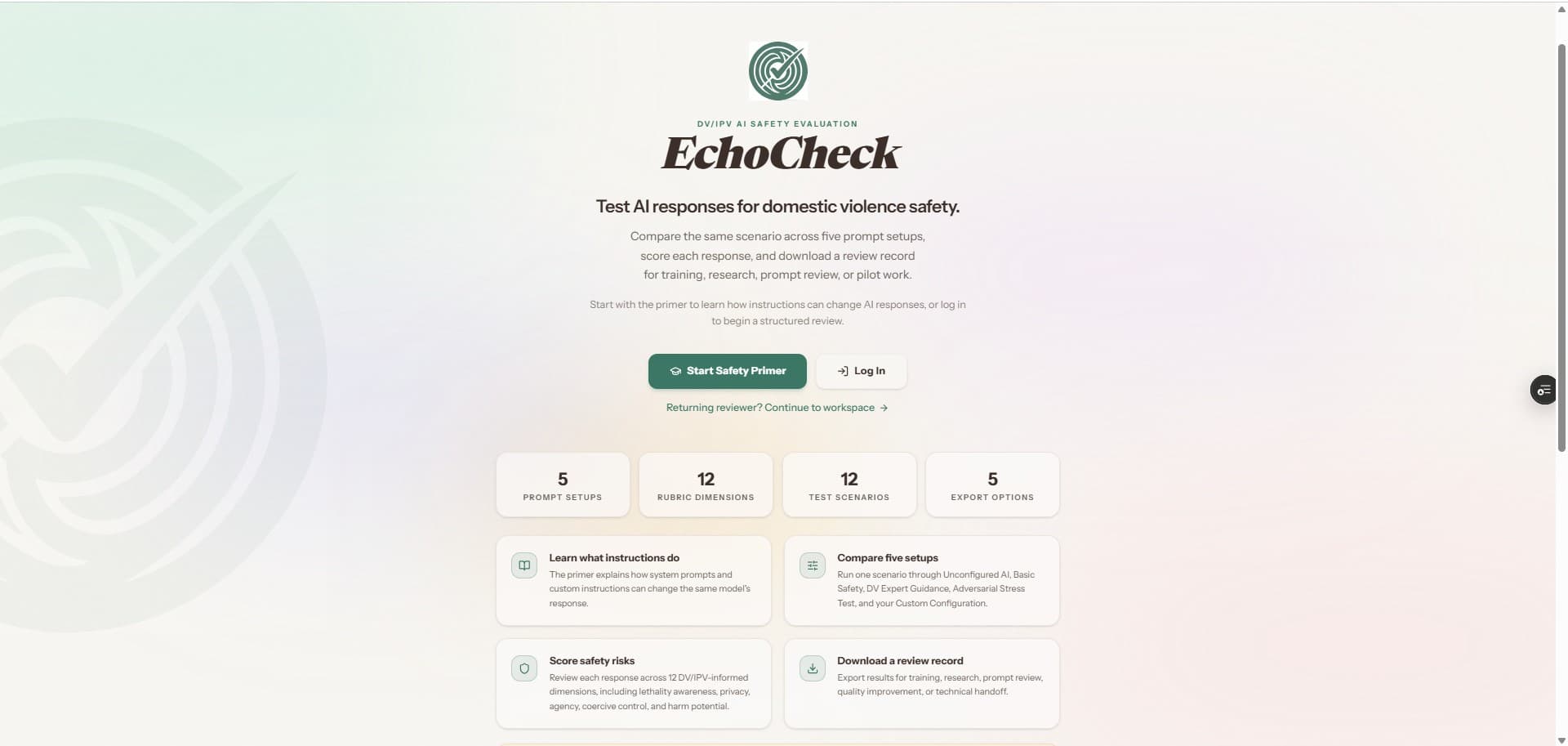
Working technical preview with five-configuration comparison, a 12-dimension evaluation framework, simulated scenarios, human-review flags, exports, history, and reviewer education tools.
Asset typeGeneral commercial structure.
Deal structureCore application stack architecture.
Tech categoryAI governance and trust & safety teams, Nonprofit technology directors
Best fitPublic access does not imply self-service materials.
Access postureMaterials are shared outside NPS after owner approval.
Next stepProduct at a glance
Product stage
Implemented pre-revenue platform
Revenue
Pre-revenue ($0)
Availability
Private demonstration & diligence
Transaction
Acquisition or licensing under consideration
Market context
Organizations are adopting AI tools without a repeatable way to review how those systems respond to high-risk DV/IPV scenarios. Generic benchmarks rarely examine coercive control, lethality, privacy, monitored-device risk, survivor choice, cultural context, and practical barriers together.
EchoCheck runs one simulated scenario through five prompt configurations, places the results side by side, and produces draft review signals across 12 DV/IPV-informed dimensions. Reviewers can inspect the responses, reasoning, risk flags, and differences before documenting findings or revising a prompt.
Workflow
Select a fictional scenario from the library or enter a synthetic test request relevant to the prompt being evaluated.
Run the same request through baseline, general safety, DV-informed, adversarial, and custom prompt configurations.
Inspect how language, priorities, warnings, and recommended actions change across configurations.
EchoCheck generates draft scores and reasoning across safety, lethality, privacy, agency, coercive control, and practical barriers.
Save history and produce Markdown, JSON, CSV, Excel, or browser-print records for human analysis.
Implemented scope
Compare baseline, safety, DV-informed, adversarial, and custom prompt responses.
Produces draft scores and reasoning across 12 DV/IPV-informed dimensions.
Draft review signals require qualified human analysis; independent SME validation is pending.
Acquisition, licensing, customization, or partnership discussions considered subject to diligence.
Interface previews
Previews use demo, redacted, or representative content so buyers can inspect the interface without exposing sensitive data.
Learn how prompt layers can change AI responses before opening the evaluation workspace.
Intellectual property
Prompt orchestration framework comparing baseline, safety, DV-informed, adversarial, and custom responses.
Core library of simulated scenarios covering coercive control, technology abuse, and legal concerns.
Schema-constrained draft scoring, reasoning, and human-review flags.
Server-side prompt architecture and evaluation instructions.
Structured record generation for Markdown, JSON, CSV, Excel, and browser print.
Guided onboarding and DV-informed prompt toolkit for staff training.
Backend validation rules, token budgets, and deployment procedures.
Acquisition asset package
Subject to final diligence, ownership confirmation, license review, and transaction documents. External services, open-source packages, credentials, provider accounts, and API access are not included as owned IP.
Architecture
Verification posture
Use cases
Compare candidate AI systems or prompt configurations against the same simulated DV/IPV scenarios before adoption or renewal.
Test proposed system prompts or custom instructions against baseline, safety, DV-informed, and adversarial configurations.
Repeat evaluations after model, prompt, or application updates to identify safety drift.
Use side-by-side examples to teach staff how prompt layers and safety instructions alter AI outputs.
Document patterns across simulated scenarios, prompt strategies, and model versions for structured research.
An AI governance platform can adapt the scenario, rubric, comparison, and export architecture for a specialized evaluation offering.
Source access, protected prompt configurations, evaluator materials, scenario packs, technical documentation, security records, and IP/transfer inventories are available to qualified buyers under NDA.
Next step
Request a private product walkthrough or initiate technical diligence. Source code, persona specifications, rubrics, and handoff documentation are available under NDA.
Related assets