

Public overview
AvailablePublic pages provide buyer-centered positioning, fit, use cases, and a controlled next step without implementation details.
Asset brief
Protectly is a controlled-review Texas protective-order drafting platform with survivor intake, advocate review, admin oversight, AI-assisted drafting support, document export, backend-mediated draft sync, and state e-filing simulation. It is controlled-review and pilot-oriented under qualified operator conditions, but not represented as a public launch, legal service, production data system, or proven live court-filing operation until database security rules, storage security rules, current automated testing, target-environment readiness, legal, privacy, safety, accessibility, monitoring, backup/restore, and e-filing credential validation are complete.
Texas protective-order drafting with guided intake, advocate review, and credential-gated e-filing
Asset type
Texas Protective Order Workflow Platform
Guided intake, advocate review, AI-assisted drafting, document export, and state e-filing simulation.
Demo posture
Private controlled demo and
Private controlled demo and diligence review only. No live users, public launch, court acceptance, legal signoff, or successful live e-filing is claimed from the reviewed evidence.
Best fit
Texas legal aid, DV coalitions, and court-adjacent operators prepared for responsible launch validation.
Texas DV survivors seeking protective-order drafting support through a qualified operator, Legal aid organizations
Buyer paths
Acquisition · Pilot License · Self-Hosted License
Trust signals
Public-safe indicators buyers can use before requesting deeper materials.
Product thesis
Protective-order access in Texas requires survivors to navigate complex legal forms, safety risks, court processes, and limited legal-aid capacity, often under urgent conditions. Protectly was built to reduce drafting friction without removing human judgment from the process. It converts plain-language survivor intake into structured case data, routes the matter to an advocate or legal professional for review, and keeps filing authority behind a deliberate confirmation workflow.
Protective-order drafting is high stakes and hard to scale. Survivors need clear, safe, plain-language intake. Advocates need structured case data, document previews, review controls, and filing safeguards. Buyers need a product that is technically mature but honest about the legal, privacy, security, and court-integration work required before public launch.
Protectly provides a controlled Texas protective-order workflow across three roles: survivor intake, advocate review, and admin oversight. Survivors complete guided intake. AI-assisted services help structure narratives and drafting support through a backend proxy. Advocates review, correct, approve, and confirm documents before filing. State e-filing runs in simulation mode by default, with live operation requiring buyer-owned credentials, environment configuration, and external filing verification.
Capabilities
These are the product behaviors, workflows, and evidence points a buyer can scan before requesting deeper materials.
Survivor intake routes into advocate review before filing confirmation.
AI and mapping keys remain server-side through the backend.
Mock e-filing envelopes are available while live mode stays credential-gated.
Privacy claims are bounded by data flows and deployed-header verification.
Interface previews
Previews use demo, redacted, or representative content so buyers can inspect the interface without exposing sensitive data.
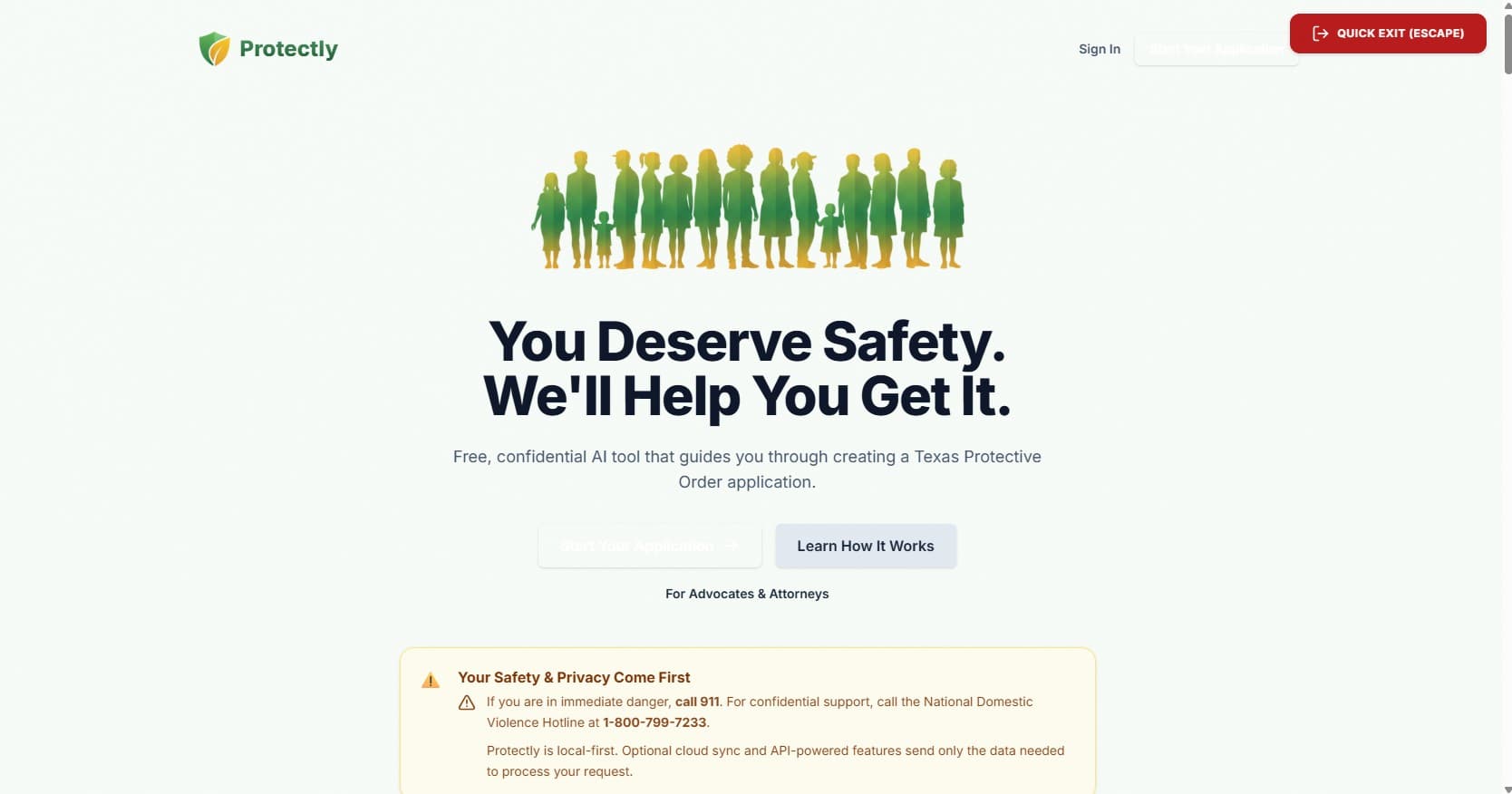
Actual Protectly app screenshot. Public-safe preview with no survivor data shown.
Use cases
A legal aid team receives structured survivor intake records, reviews extracted case data, edits documents, and confirms filing readiness.
A DV organization pilots guided protective-order drafting with trained advocates before broader public deployment.
A court modernization partner evaluates e-filing simulation envelopes and validates live-mode requirements before activation.
A prospective acquirer runs CI, reviews canonical docs, validates environment needs, and scopes pre-launch legal and security work.
Review package
The public brief gives buyers a safe first pass. Deeper implementation and operational materials stay controlled by fit review.
Documentation
Public overview available. Detailed documentation is gated for controlled review.
Review by request
Testing / QA
QA evidence is available in controlled review and should be freshly verified before buyer reliance.
Controlled review
Transfer boundary
Transfer scope is reviewed privately during app-specific diligence.
Controlled review
Included assets
Commercial paths
Controlled Pilot License
Limited pilot for a qualified Texas legal aid, DV, or court-adjacent partner with legal review, safety review, and restricted launch scope.
Self-Hosted License
Source-code license for an operator that wants to host the frontend, backend, authentication/database configuration, and supporting services under its own governance.
Implementation Partnership
Customization and launch-support path for organizations needing Texas-specific workflow adaptation, compliance hardening, and launch support.
Full Acquisition
Transfer of source code, documentation, controlled review materials, environment configuration, and product roadmap for a qualified buyer.
Evidence and review posture
This section shows only public-safe evidence language. Deeper technical, security, billing, operational, transfer, and implementation materials stay gated.
Public pages provide buyer-centered positioning, fit, use cases, and a controlled next step without implementation details.
A private walkthrough can be requested for qualified review. No public demo access is implied.
QA evidence is available in controlled review and should be freshly verified before buyer reliance.
Technical, security, billing, operational, transfer, and implementation materials are gated and are not included in the public portfolio payload.
Public pages are designed for discovery: product overview, use case, high-level features, category, and public-safe readiness summary. Deeper technical, security, billing, operational, transfer, and implementation materials are shared selectively after review.
Roadmap
Roadmap labels distinguish completed work from active hardening or planned next steps.
FAQ
From the blog
Controlled next step
Start with a fit conversation. Public summaries stay safe to browse; technical, security, and transfer materials are shared only when the review path is appropriate.
Related assets