

Public overview
AvailablePublic pages provide buyer-centered positioning, fit, use cases, and a controlled next step without implementation details.
Asset brief
Haven is an active-hardening crisis simulation trainer for domestic violence hotline operators and advocate training programs. The connected repo implements a browser-based frontend, a backend service with a real-time voice AI proxy, post-call analysis, secure authentication, session history, custom scenarios, audit events, quotas, and a managed cloud hosting environment.
Voice-based crisis hotline simulation with live AI coaching and post-call analysis
Asset type
Voice-Based Crisis Hotline Simulation Trainer
Active-hardening browser-based simulation platform with live AI voice sessions, post-call analysis, scenario authoring, history, mastery analytics, secure authentication, a managed database, and cloud hosting.
Demo posture
Controlled walkthrough available by
Controlled walkthrough available by request. Buyer-facing claims should be verified with current lint, build, unit tests, emulator-backed end-to-end checks, database rules checks, microphone functional test, and health/readiness endpoint evidence.
Best fit
Crisis hotlines, DV coalitions, advocate onboarding programs, social work training programs, and simulation platforms seeking voice-based practice for hotline skills.
Domestic violence hotline training coordinators, New advocate onboarding programs
Buyer paths
Pilot • License • Acquisition • Training Partnership
Trust signals
Public-safe indicators buyers can use before requesting deeper materials.
Product thesis
Hotline and advocacy trainees need realistic, repeatable practice before supporting people in crisis. Haven gives trainees a browser-based simulation environment where they can practice de-escalation, active listening, safety planning, and scenario-specific decision-making, then review post-call feedback and progress over time.
New hotline advocates often move from classroom concepts to live crisis support with limited realistic practice. Text, voice, safety planning, escalation, silence, uncertainty, and caller emotion are hard to rehearse consistently with human role-play alone. Training programs need a safe, repeatable simulation environment with scenario structure, feedback, and skill progression.
Haven provides a browser-based voice simulation workflow. Trainees authenticate, choose built-in or custom scenarios, start a microphone-enabled live AI session through a backend proxy, complete the simulation, receive post-call analysis, and review saved history and mastery analytics. The backend keeps AI credentials server-side, verifies user tokens, enforces quotas and concurrency limits, validates analysis payloads, and writes audit events.
Capabilities
These are the product behaviors, workflows, and evidence points a buyer can scan before requesting deeper materials.
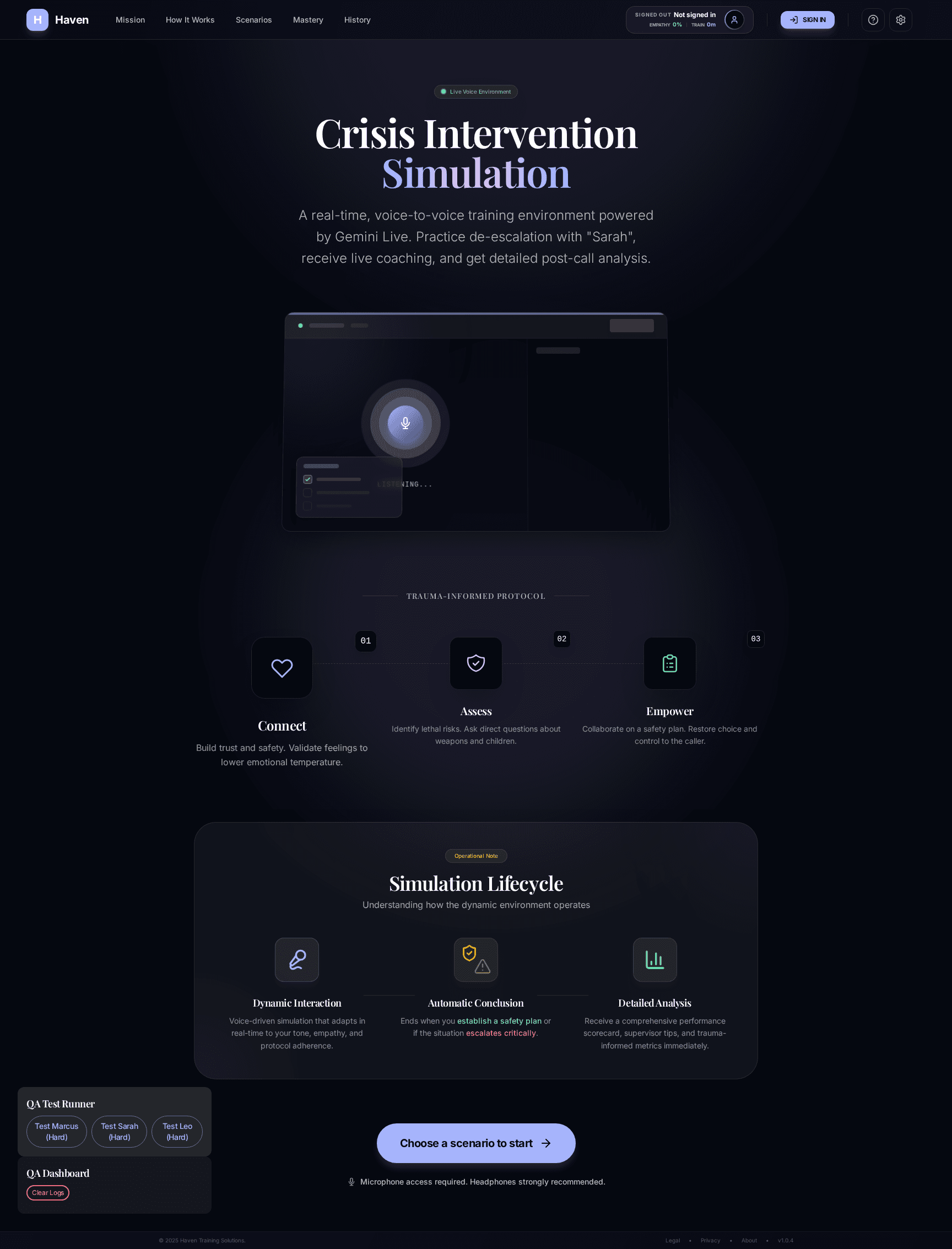
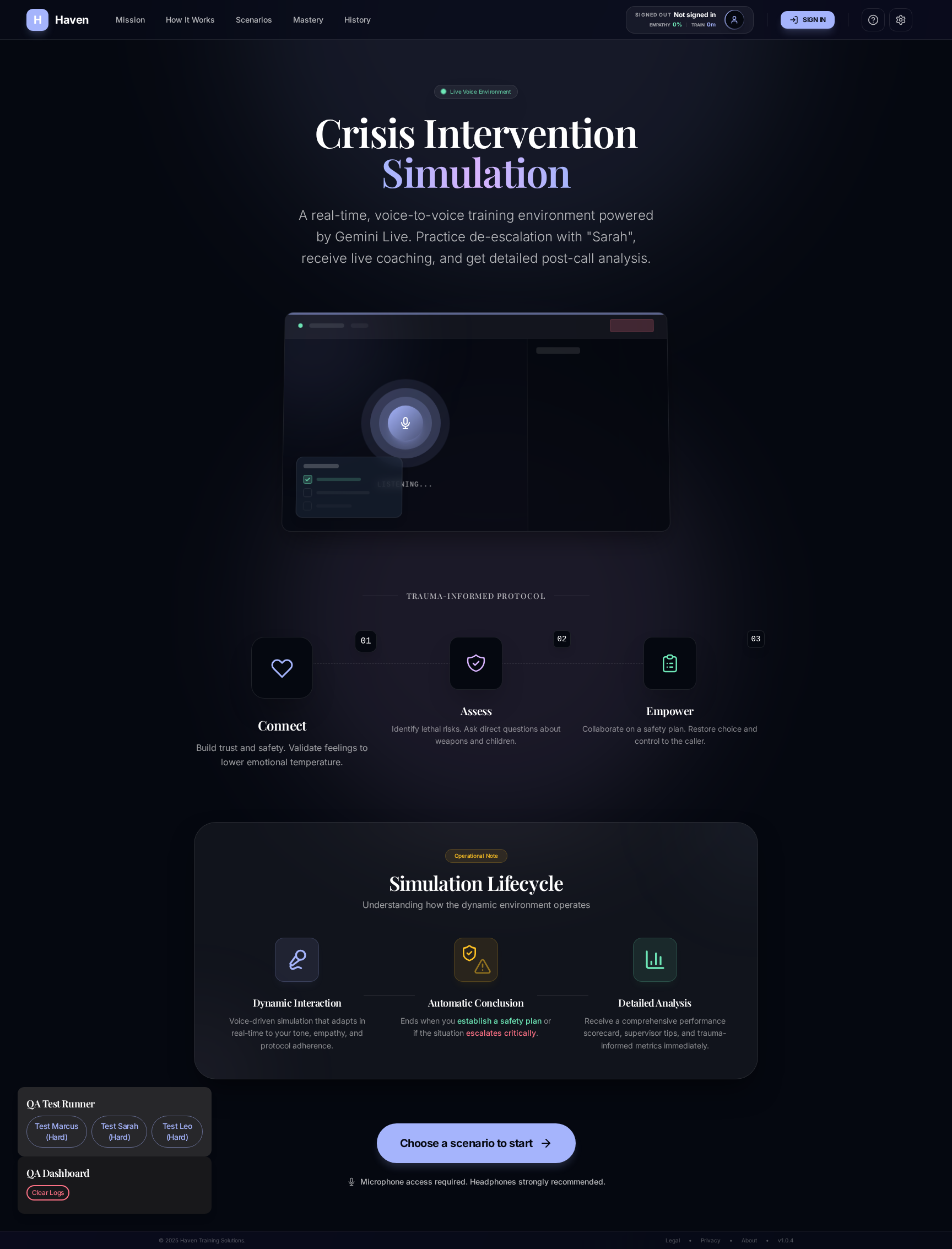
Public-safe Haven landing screenshot replacing the previous diagram-only placeholder on public app surfaces.
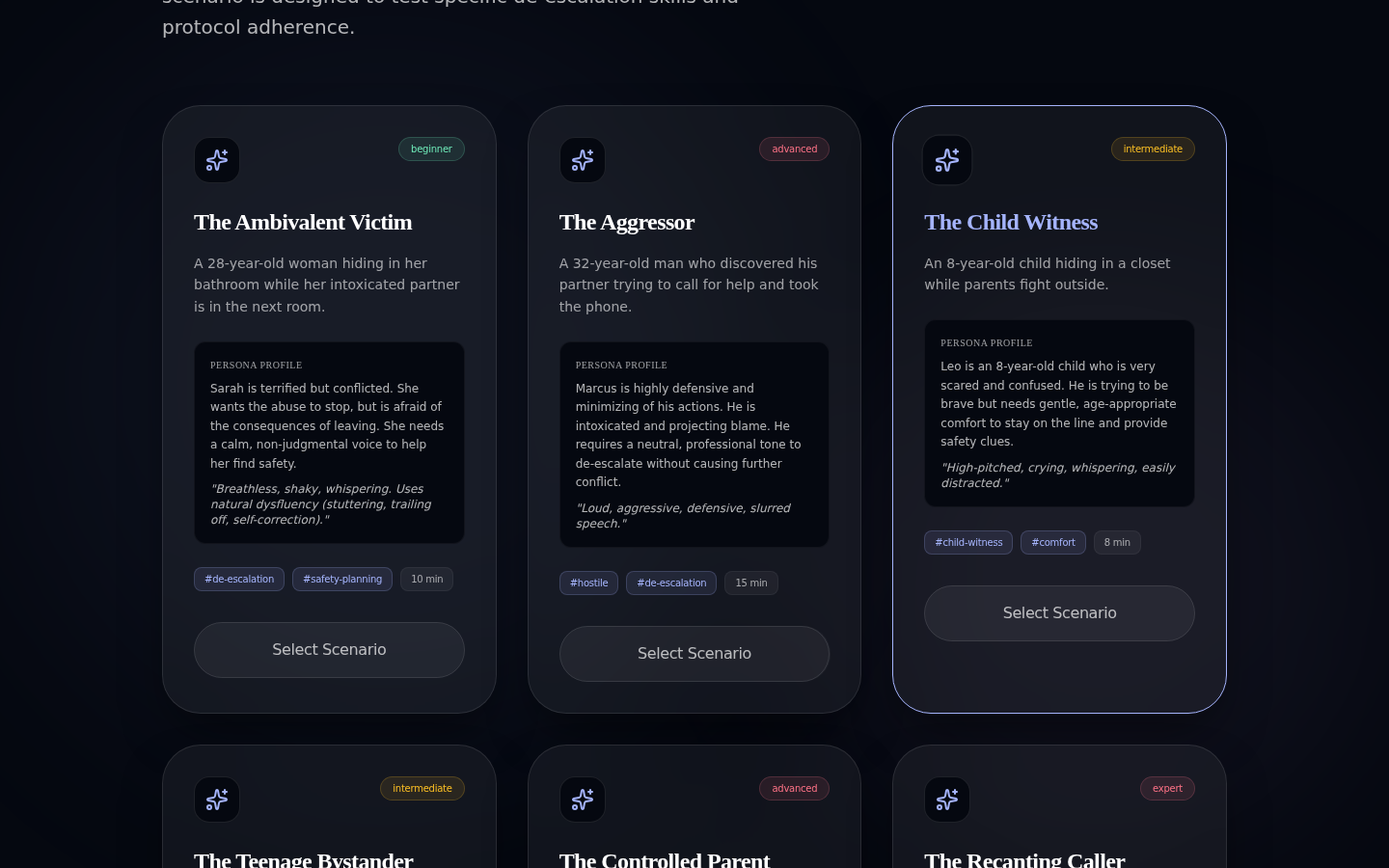
Built-in training scenarios support structured crisis hotline practice before live caller work.
Authentication, AI proxying, rate limits, quotas, concurrency controls, and audit events are documented for diligence.
Interface previews
Previews use demo, redacted, or representative content so buyers can inspect the interface without exposing sensitive data.
Actual Haven app screenshot. Public-safe preview with no sensitive caller or trainee data shown.
Use cases
Trainees complete realistic voice simulations before moving into supervised hotline or chat work.
Training coordinators assign scenarios focused on de-escalation, safety planning, trust-building, or difficult caller dynamics.
Programs create their own scenario modules or custom scenarios to reflect local hotline patterns and coaching priorities.
Trainees review results, history, and mastery data to identify strengths and practice goals.
A DV coalition pilots Haven with a small training cohort while validating privacy, database access rules, microphone flow, accessibility, and release controls.
Review package
The public brief gives buyers a safe first pass. Deeper implementation and operational materials stay controlled by fit review.
Documentation
Public overview available. Detailed documentation is gated for controlled review.
Review by request
Testing / QA
QA evidence is available in controlled review and should be freshly verified before buyer reliance.
Controlled review
Transfer boundary
Transfer scope is reviewed privately during app-specific diligence.
Controlled review
Included assets
Commercial paths
Controlled Pilot
Limited pilot for a hotline or DV training program after current build, test, end-to-end, database rules, microphone, privacy, and accessibility checks.
Source-Code License
License the frontend, backend service, live AI proxy, authentication and database integration, scenario registry, and runbook materials for buyer-operated infrastructure.
Training Partnership
Customize scenario libraries, rubrics, mastery dashboards, and training workflows for a DV coalition, hotline, or social work training program.
Full Acquisition
Acquire source code, scenario framework, live AI proxy, backend architecture, post-call analysis workflow, runbooks, and transition support under negotiated terms.
Evidence and review posture
This section shows only public-safe evidence language. Deeper technical, security, billing, operational, transfer, and implementation materials stay gated.
Public pages provide buyer-centered positioning, fit, use cases, and a controlled next step without implementation details.
A private walkthrough can be requested for qualified review. No public demo access is implied.
QA evidence is available in controlled review and should be freshly verified before buyer reliance.
Technical, security, billing, operational, transfer, and implementation materials are gated and are not included in the public portfolio payload.
Public pages are designed for discovery: product overview, use case, high-level features, category, and public-safe readiness summary. Deeper technical, security, billing, operational, transfer, and implementation materials are shared selectively after review.
Roadmap
Roadmap labels distinguish completed work from active hardening or planned next steps.
FAQ
Controlled next step
Start with a fit conversation. Public summaries stay safe to browse; technical, security, and transfer materials are shared only when the review path is appropriate.
Related assets
Private voice-and-text practice for crisis-support training teams
Why it fits
Crisis hotline networks, DV/SA coalitions, advocate training programs, nonprofit learning platforms, and mission-aligned workforce development teams.
Scenario-based BIPP facilitator practice and supervisor review
Why it fits
BIPP administrators, state oversight agencies, and workforce development platforms seeking structured facilitator practice and supervisor review infrastructure.
Immersive domestic violence education simulation with hybrid branching and analytical debrief
Why it fits
EdTech platforms, DV coalitions, clinical and social work education programs, healthcare training teams, first responder training providers, and simulation-learning buyers.