Public overview
AvailablePublic pages provide buyer-centered positioning, fit, use cases, and a controlled next step without implementation details.
Asset brief
Texas Legislature Tracker, also referred to as TX Legislative Tracker, is an active-hardening civic technology platform for Texas advocacy teams. It helps users monitor Texas bills, legislators, committees, districts, hearings, and AI-assisted advocacy workflows through a browser-based application, backend serverless functions, a database, a public legislative data API, official Texas Legislature hearing feeds, and AI-backed policy tools.
Policy intelligence workspace for Texas advocacy teams

Asset type
Policy Intelligence Platform
Texas-focused policy intelligence workspace with AI-assisted workflows, legislative ingestion, and demo-gated release operations.
Demo posture
Demo-gated. Buyer demo is
Demo-gated. Buyer demo is viable only after the exact demo commit passes install, validation, tests, build, E2E smoke, QA audit scripts, dependency audit, hosting launch status, and live health/freshness checks. Demo routes that require authentication should be preflighted with a known-good account because there is no self-serve signup path.
Best fit
Civic tech platforms, policy intelligence SaaS teams, and advocacy organizations seeking a Texas-first tracker with transparent hardening gates.
DV/SA advocacy organizations, State coalition policy staff
Buyer paths
License • Acquisition • Integration • Partnership
Trust signals
Public-safe indicators buyers can use before requesting deeper materials.
Product thesis
Texas legislative sessions move quickly, and resource-constrained advocacy teams cannot manually monitor every bill, committee action, legislator, district, and hearing that may affect their work. The tracker exists to centralize legislative context, reduce manual filtering, and help policy staff move from information gathering to timely advocacy decisions.
Advocacy teams need to track Texas bills, committees, legislators, districts, deadlines, and hearing activity, but generic government affairs tools are often too broad, expensive, or disconnected from nonprofit policy workflows. Without a shared tracker, teams risk missing bill movement, duplicating research, or reacting too late.
Texas Legislature Tracker combines public legislative data ingestion, backend-persisted tracking, map and legislator views, bill detail workflows, AI-assisted analysis tools, campaign drafting, and health/freshness checks. It is designed for controlled demos and buyer evaluation after exact-commit release gates, launch status, and live smoke evidence are verified.
Capabilities
These are the product behaviors, workflows, and evidence points a buyer can scan before requesting deeper materials.
Texas bill list and bill detail workflows
Legislator, committee, district, and map views
Public legislative data API integration with cache-fronted access
Official Texas Legislature hearing and calendar feed ingestion
Nightly sync for bill data, hearing events, sync status, and optional AI embeddings
Backend-persisted storage for tracked bills, notes, campaigns, and audit logs
AI Intel workspace with 12 tools
Core bill analysis focused on survivor, service provider, and legal-system implications
Campaign draft save path for advocacy workflows
Heuristic bill progress tracker based on sponsor count, activity, chamber movement, and status
AI gateway with authenticated access, validation, user rate limiting, tier checks, and telemetry
Health endpoint for backend, data API, AI, feed, and cache checks
Freshness endpoint for bill, legislator, committee, and hearing-feed data signals
Quick Exit safety feature using triple-Esc behavior
Recursive PII redaction and structured audit logging for sensitive ingress and egress paths
Production mock fallback policy that prevents silent mock-data fallback in production
Interface previews
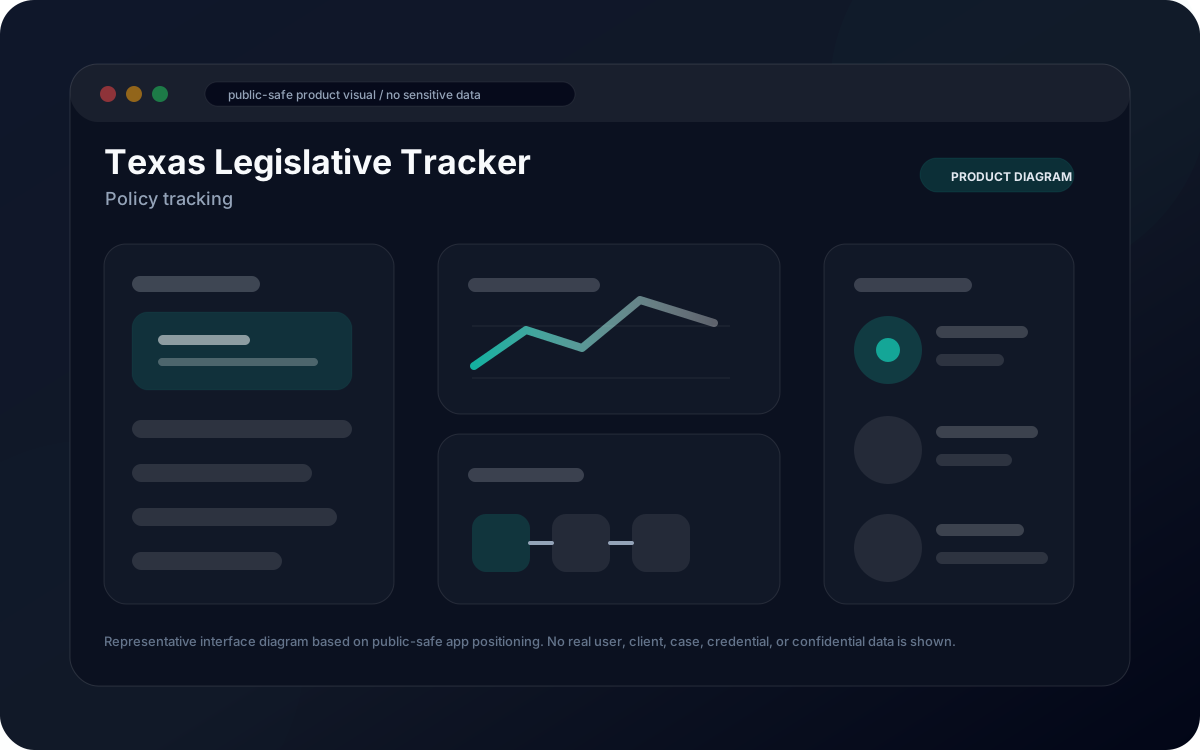
Previews use demo, redacted, or representative content so buyers can inspect the interface without exposing sensitive data.

Actual Texas Legislature Tracker screenshot. Public-safe preview.
Use cases
Policy staff review current Texas bills, legislators, committees, deadlines, and district context from one advocacy-focused workspace.
A user selects a bill and runs AI tools for concise summary, stakeholder impact, community impact, opposition analysis, or evidence discovery.
Authenticated users draft and save campaign materials tied to specific bills after reviewing context and AI-assisted messaging.
A product owner runs the preflight checklist, verifies serverless APIs, confirms freshness, signs in with a known-good demo account, and follows the recommended click path.
Review package
The public brief gives buyers a safe first pass. Deeper implementation and operational materials stay controlled by fit review.
Documentation
Public overview available. Detailed documentation is gated for controlled review.
Review by request
Testing / QA
QA evidence is available in controlled review and should be freshly verified before buyer reliance.
Controlled review
Transfer boundary
Transfer scope is reviewed privately during app-specific diligence.
Controlled review
Included assets
Commercial paths
Controlled buyer evaluation
Private review of repository, architecture, security posture, runbooks, AI tools, and demo path after preflight gates pass.
Source-code license
License the browser-based, serverless-backed, database-driven, and AI-assisted application for buyer-operated infrastructure with setup support defined by agreement.
Advocacy platform integration
Adapt the tracker into an existing policy, advocacy, or government affairs platform with buyer-specific data sources, alerts, and entitlements.
Full acquisition
Transfer source code, documentation, runbooks, licensing terms, deployment patterns, data-ingestion scripts, AI tooling patterns, and transition support under negotiated terms.
Evidence and review posture
This section shows only public-safe evidence language. Deeper technical, security, billing, operational, transfer, and implementation materials stay gated.
Public pages provide buyer-centered positioning, fit, use cases, and a controlled next step without implementation details.
A private walkthrough can be requested for qualified review. No public demo access is implied.
QA evidence is available in controlled review and should be freshly verified before buyer reliance.
Technical, security, billing, operational, transfer, and implementation materials are gated and are not included in the public portfolio payload.
Public pages are designed for discovery: product overview, use case, high-level features, category, and public-safe readiness summary. Deeper technical, security, billing, operational, transfer, and implementation materials are shared selectively after review.
Roadmap
Roadmap labels distinguish completed work from active hardening or planned next steps.
FAQ
From the blog
Controlled next step
Start with a fit conversation. Public summaries stay safe to browse; technical, security, and transfer materials are shared only when the review path is appropriate.
Related assets