
Policy Work Needs a Better Operating Surface
Texas Legislature Tracker pulls bills, districts, legislators, committees, and advocacy drafting into one place, so a small team can get from information to action without stitching five systems together by hand.
By Prosocial Coding LLC (Ryan Thomas)
Policy work has a recurring problem: the information all exists, but it is scattered across so many systems that it is hard to use at the speed advocacy usually demands. A bill page tells you one thing. A committee roster tells you another. A district map gives you context but not a workflow. Your notes live somewhere else again, and the outreach draft happens last, under pressure, in a separate document. The facts are public. Assembling them into a next step is the slow part.
I wanted a tool that treated legislative work as a connected process instead of a scavenger hunt. This is an independent Prosocial Coding LLC project, separate from my day job. My years in the domestic violence field shaped how I think about safety, privacy, and the quiet ways software can let people down, and that shows up throughout this tool even though the subject is policy rather than crisis.
That last point is what organizes the build. Policy software rarely fails loudly. It fails quietly. It lets stale data look current. It produces AI text that sounds confident and skips the caveats. It exposes a team's strategy, or leaks a credential through a sloppy boundary between browser and server, or nudges someone into trusting generated language before a human has read it. Those are the failures I built against, because they are the ones nobody notices until they have already cost something. The question I ask before any feature is the same one I would ask of a crisis tool: could this harm someone? Here the harm is quieter, which makes it easier to miss and more important to design for.
What it does
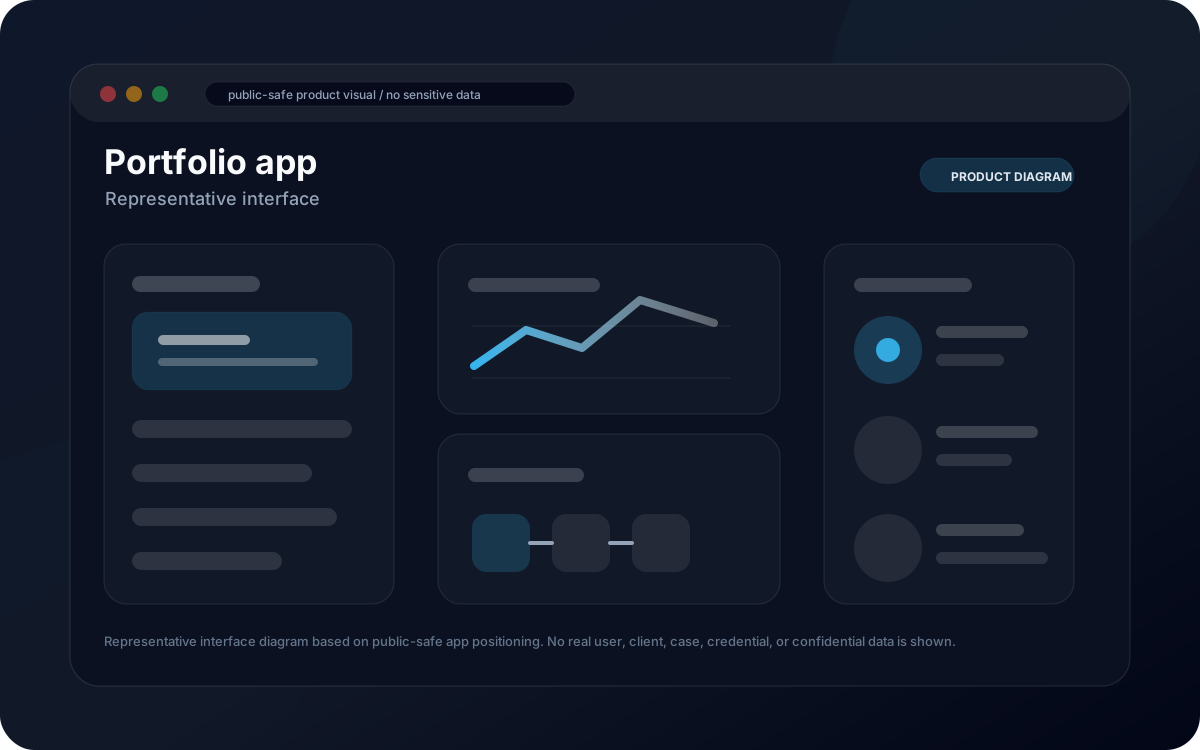
Texas Legislature Tracker pulls bills, districts, legislators, committees, and advocacy drafting into one place, so a small team can get from information to action. The public side lets anyone browse bills, legislators, committees, organizations, session deadlines, events, and a Texas district map. Signing in adds saved workflows and campaign drafting.
The workflow is built to let you start anywhere, because policy work rarely begins with the facts in order. Sometimes you know the district before you know the official. Sometimes you have the bill number before you know which committee holds it. You can open the map when geography is the way in, click into a district, pull up a legislator, check their committees, move into a bill, read its summary and history, run an analysis, and save a campaign draft, all in one path. Every one of those tools is there to assist a person, not to replace the judgment that makes advocacy work.
Who it is for
This is for the people who do policy and advocacy work without a dedicated legislative operations platform behind them: advocates, coalition staff, researchers, public affairs workers, organizers, and small teams. It earns its place for anyone who has to hold three kinds of context at once: what a bill says, who has influence over it, and what their team needs to prepare next. The tool does not make that work easy, and I would not claim it does. What it does is take the drag out of the assembly, so more of a person's time goes to strategy, judgment, and review instead of to clicking between systems.
The safety work
Advocacy work can be sensitive, and the person doing it is not always safe in the room they are in. The application includes a Quick Exit button that allows a user to exit the interface quickly to a neutral site if needed. Row-level protections keep user-owned records, including profile and campaign details, secure. Input and output validation gates run on all data requests to ensure integrity, and personal information is automatically redacted from logs and system actions.
What it does not prove
The safety work is real, but it is not a substitute for human review. Public materials provide discovery summaries and high-level details, but they do not guarantee service health, data freshness, or production certification. Users should verify data against official legislative sources before relying on it for high-stakes decisions.
Where it is going
Future priorities include cleaner onboarding for institutional users, stronger release evidence, better live data-freshness checks, and improved review controls. The goal is to continue taking the administrative drag out of policy work, leaving more room for human judgment, timing, and strategy.
Related articles
Rehearsing a Crisis Call Before the Call Is Real
CallCraft is a practice space for crisis-support conversations. A participant picks a scenario, chooses a difficulty level, and enters a practice session with a simulated caller.
ProductsAn AI answer can sound right and still be dangerous
EchoCheck is a workbench for judging AI responses in survivor-serving contexts, built for reviewers who need more than a 'looks good' to go on.
ProductsDesigning for the Edge: Guided Protective Order Drafting
Protectly is a guided drafting tool for Texas protective order materials. The app walks a user through a guided intake, step by step: who they are, who they are filing against, the relationship, who needs protection, what happened, and what they are asking the court to prohibit, keeping key facts organized.